For the third consecutive season, the Big Ten will play for the national championship. This time, the conference arrives not on the shoulders of its traditional powers, but through two programs that reflect its rapidly changing identity.
Indiana and Oregon — one a long‑suffering Midwestern underdog, the other a newly arrived West Coast contender — have reached the national semifinal together. Their parallel climbs ensure that the Big Ten’s logo will appear on the sport’s biggest stage once again, underscoring the league’s expanding reach and deepening competitive base.
Indiana’s Rise Reshapes Expectations
Indiana’s presence in the playoff marks one of the most significant breakthroughs in college football history. Long defined by near‑misses and incremental progress, the Hoosiers have finally broken through with a veteran roster and a system built on tempo, discipline, and opportunistic defense. Indiana’s offense features a Heisman Trophy winner at quarterback in Fernando Mendoza.
They didn’t back into the bracket. They earned it with ranked wins, late‑game execution, and a season‑long ability to dictate style. Indiana’s run under Curt Cignetti signals a shift in the conference hierarchy: the middle of the league is no longer passive. It’s producing legitimate national contenders.
Oregon Delivers on the Promise of Expansion
Oregon entered the Big Ten with questions about travel, fit, and tradition. What was never in doubt was the Ducks’ competitive value. This season has validated that belief.
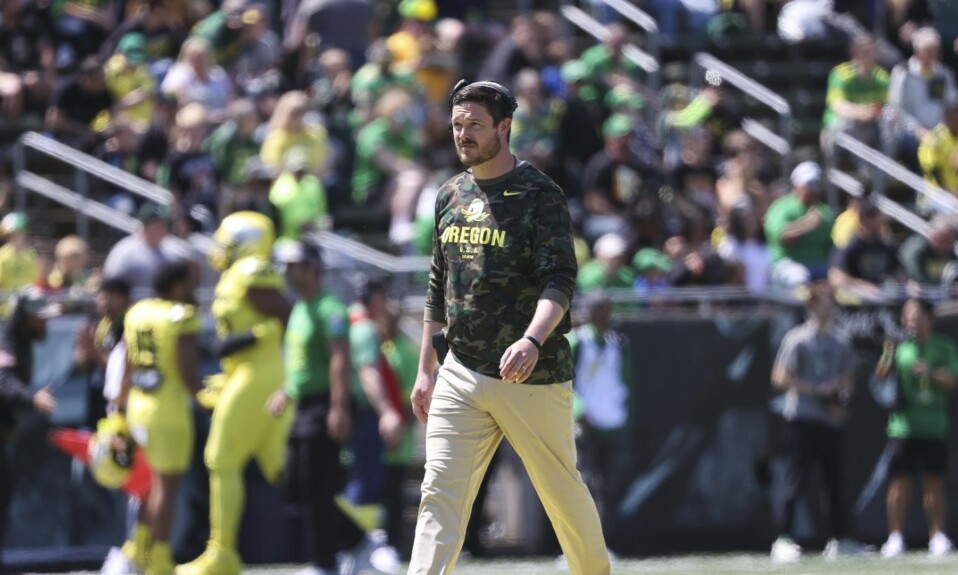
Oregon remains one of the nation’s most balanced teams, pairing its trademark offensive creativity led by quarterback Dante Moore with a defense capable of controlling games. Their playoff berth is less a surprise than a confirmation — the Ducks were added to strengthen the league’s national profile, and they’ve done exactly that. Oregon head coach Dan Lanning has served notice that the Ducks will be a factor on the national scene for seasons to come.
By joining Indiana in The Peach Bowl, Oregon has helped guarantee the Big Ten another shot at the title, reinforcing the strategic logic behind the conference’s western expansion.
A Conference Built on Breadth, Not Just Brands
For decades, the Big Ten’s national hopes rose and fell with Ohio State and Michigan. Their rivalry shaped the league’s identity and its postseason expectations.
This year tells a different story.
Indiana and Oregon represent a conference no longer dependent on a single flagship. The Big Ten now spans four time zones and fields multiple programs capable of reaching the sport’s final weekend. Its strength is structural, not situational.
That’s how a league produces three straight national championship appearances. That’s how it sustains relevance in an era defined by realignment and rapid change.
A New Era, Already Taking Hold
Whether Indiana’s breakthrough continues or Oregon’s balance prevails, the Big Ten has already secured something meaningful: a place in the national title game and a clear signal that its competitive future is broader than ever.
The conference wanted to become the sport’s gravitational center. With Indiana and Oregon meeting on the playoff stage, that vision looks less like ambition and more like reality.