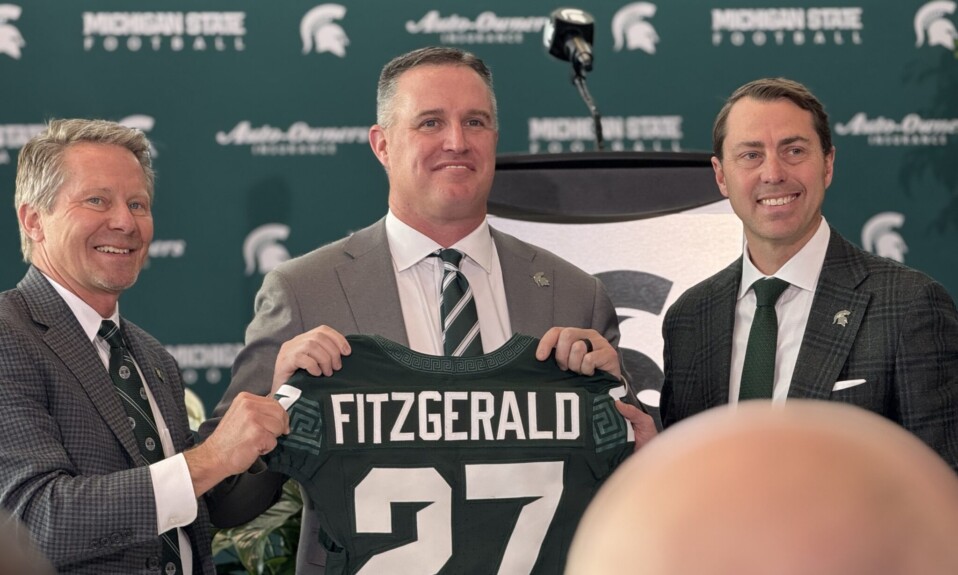
The lights flick on early at the Spartans’ practice facility, long before most of campus stirs. A cold Michigan morning hangs in the air, but inside, the tempo is already rising—whistles, footsteps, sharp commands cutting through the quiet. This is spring football under Pat Fitzgerald, and at Michigan State Spartans football, the tone has unmistakably changed.
There is no easing into this era. From the first practice, Fitzgerald has made it clear: this is a reset, not a continuation.
A Different Kind of Spring
Spring football often carries a sense of optimism—new depth charts, position battles, flashes of potential. In East Lansing this year, it feels more like reconstruction. Every drill, every rep, every meeting carries weight. Players aren’t just competing for roles; they’re learning what it means to be part of this version of Michigan State football.
Fitzgerald moves through practice with purpose, rarely raising his voice but commanding attention all the same. His presence is constant—hovering near position groups, stepping into drills, correcting technique, reinforcing expectations. It’s not just about execution. It’s about habits.
“Details matter” has become something of an unofficial mantra. Footwork. Alignment. Effort after the whistle. The small things, repeated until they’re no longer small.
Rebuilding From the Inside Out
The roster Fitzgerald inherited is a mix of returning players, transfers, and newcomers still adjusting to the speed and structure of Big Ten football. That reality has shaped the entire spring approach.
Instead of installing everything at once, the staff is building deliberately. Periods are structured, teaching is constant, and repetition is non-negotiable. There are fewer shortcuts here—if a concept isn’t right, it gets repped again. And again.
For veterans, the adjustment is as much mental as physical. Familiar routines have been replaced. Expectations have shifted. Leadership is being redefined—not by seniority, but by consistency.
You can see it in the way players linger after drills, asking questions. In the extra sprints run without prompting. In the sideline conversations that carry a little more urgency.
Controlled Chaos on Offense
On one side of the ball, the offense is finding its rhythm in pieces. There are flashes—sharp routes, quick reads, a well-timed deep ball—but also the inevitable growing pains of a new system.
Quarterbacks rotate through reps, each trying to establish command. Timing with receivers is still developing, and the offensive line is working to build cohesion in both pass protection and the run game. It’s not always smooth, but it’s competitive.
What stands out is the pace. Practices move quickly, with little downtime between periods. Mistakes aren’t dwelled on—they’re corrected, then the next snap comes almost immediately.
It’s demanding, but intentional. The goal isn’t perfection in March. It’s progress by fall.
Defense Sets the Tone
If the offense is evolving, the defense already carries a clearer identity—one that reflects Fitzgerald’s roots. Physicality is non-negotiable. So is discipline.
Defensive drills are sharp, almost surgical. Angles are precise. Tackling form is emphasized repeatedly. Communication is constant, with players expected to recognize formations and react instantly.
There’s an edge, too. A noticeable intensity that surfaces during team periods, when competition peaks and the energy shifts. Big plays are celebrated briefly, then reset. The standard never drops.
It’s early, but the defense looks like it understands the assignment: be the foundation while everything else comes together.
No Curtain Call—Just Work
Notably absent from this spring is the traditional pageantry of a full spring game. Instead, Fitzgerald has opted for a more controlled finish—a modified showcase that prioritizes development over display on April 18th.
It’s a decision that fits the moment. This team isn’t chasing headlines in April. It’s building something that won’t fully reveal itself until much later.
Fans will still get a glimpse, but it won’t be the final product. Not even close.
A Culture Taking Shape
Spend enough time around the program this spring, and a pattern emerges. It’s in the structure of practice, the language of the coaches, the response of the players.
Accountability isn’t just talked about—it’s enforced. Effort isn’t requested—it’s expected. And culture isn’t a slogan—it’s something being constructed, rep by rep.
Fitzgerald’s influence is subtle in some ways, unmistakable in others. There’s a steadiness to his approach, a belief that if the foundation is right, everything else will follow.
Looking Beyond Spring
There are no bold predictions coming out of East Lansing this spring. No guarantees, no shortcuts. Just a team in the early stages of becoming something different.
What that becomes will take time.
But in the quiet moments—before the sun fully rises, before the season feels real—you can sense it starting. A shift in expectation. A new rhythm. The beginning of an identity.
Spring football doesn’t define a season. But for Michigan State, it might define something more important: the standard moving forward.