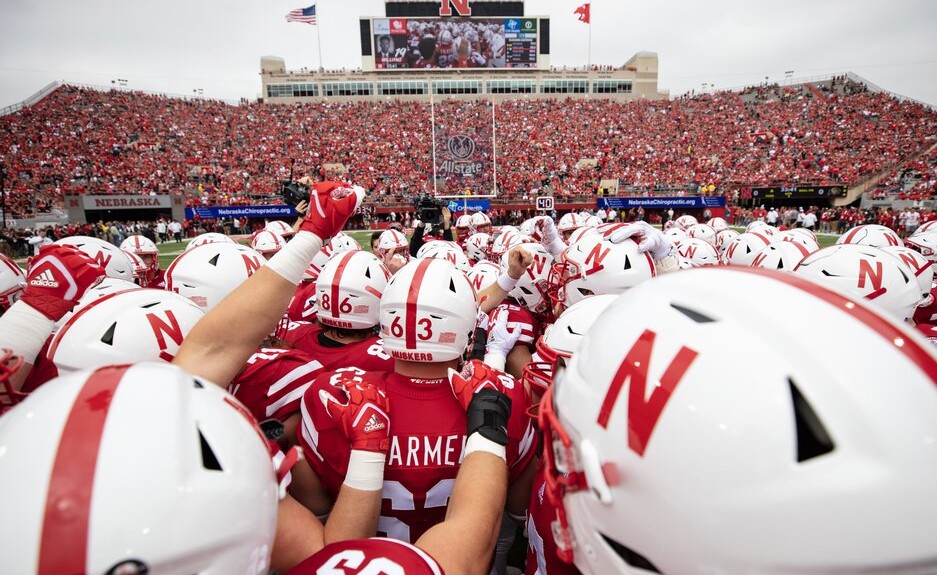
Nebraska’s quarterback room has emerged as the story of spring — not because of the long-discussed Dylan Raiola, but for the present-day competition shaping the Huskers’ offense. With Raiola now in Oregon, the focus has tightened on three experienced, distinct quarterbacks: transfer Anthony Colandrea, returning T.J. Lateef and returning transfer Daniel Kaelin. Each brings a different profile, and Matt Rhule’s staff is treating the position like a chess match: pick a leader now or let performance in the spring game and fall camp determine who manages the offense best under Nebraska offensive coordinator Dana Holgorsen.
Anthony Colandrea: the frontrunner
Colandrea arrived as the most NFL-seasoned option on paper, and spring reps have backed that up. He’s taken the bulk of first-team snaps, commanding the huddle and showing clean mechanics in Holgorsen’s tempo-based offense. Colandrea’s strengths are timing and anticipation — quick reads on shallow and intermediate concepts that keep drives moving — and a low turnover profile. Coaches appreciate his cadence control and pocket awareness when the pass rush is simulated. The biggest questions: consistent deep-ball accuracy and how he handles defined pressure packages from new defensive coordinator Rob Aurich.
T.J. Lateef: continuity and mobility
Lateef represents institutional knowledge and mobility. As a returning player, he’s comfortable with the offense’s terminology and has a rapport with the skill group built over the last few starts of the 2025 season. Spring has highlighted Lateef’s escape ability and downfield improvisation, which can flip stalled drives into chunk plays. His path to the starting job hinges on improving timing with first-team receivers, tightening ball placement on intermediate throws, and reducing decision-making lapses under scripted pressure. If the staff values dual-threat wrinkle plays and in-system chemistry, Lateef remains a credible alternative.
Daniel Kaelin: arm strength and fresh competition
Kaelin, a returning transfer with prototypical arm strength, offers a different look: power to push the field and the ability to drive the ball into tight windows. In spring, he’s been the most clearly projectable “big-arm” option, often flashing the downfield throws that can change a defense’s cover call. The trade-offs are consistency and processing speed against complex coverage shells. Kaelin’s spring aim is to show he can operate the tempo offense, hold up in blitz pickups and limit ill-timed turnovers that would stall rhythm.
Nebraska head coach Matt Rhule said of Kaelin, “When Danny was away, I think some of his best friends were still on the team, and every time he was home, he was always around these guys. So I don’t think there was a person in the building that wasn’t glad to see Danny back here. To me, he’s the true definition of a Cornhusker. He grew up loving the state and program and it’s almost like he never left, to be quite honest with you.”.
What the staff is watching
Rhule and offensive coaches have been blunt: the job won’t be decided purely on spring practice reps. They’re measuring command of the huddle, third-down efficiency, red-zone decision-making, handling of two-minute scenarios, and protection-aware play under pressure. With Aurich’s defense installing aggressive blitzes and disguise, the QB who processes checks faster and keeps the offense on schedule will earn early-season trust. Leadership traits and minimizing negative plays (turnovers, penalties on the offense) are equal tiebreakers.
Spring game and fall projection
The March 28 spring game will be the first public barometer; it won’t settle everything but will reveal who can lead a game plan and sustain drives under semi-live conditions. If Colandrea maintains his current momentum — clean reads, quick releases, limited turnovers — he’s likely to open fall as the starter. Lateef can force a change by showing refined timing with the top receivers and consistent pocket decisions. Kaelin’s path is to demonstrate reliability running the system while continuing to showcase the big-play potential that could win coaches over.
Bottom line
Nebraska’s quarterback battle is less about a single immediate star and more about matching skills to Dana Holgorsen’s offensive identity. The staff will favor the QB who combines processing speed against complex coverage, ball security, and the ability to lead in-game tempo. Expect an evolving competition: a likely early nod to experience and minimize risk for Colandrea, but plenty of runway for Lateef or Kaelin to alter the depth chart before the season opener.